
P. D'Avanzo (INAF-OAB), K.L. Page (U. Leicester) and N.P.M. Kuin (UCL-MSSL) for the Swift team
At 23:59:25 UT, the Swift Burst Alert Telescope (BAT) triggered and located GRB 210619B (trigger=1056757) (D'Avanzo et al. GCN Circ. 30261). Swift slewed immediately to the burst. At the time of the trigger, the initial BAT position was 105° from the Sun (8.6 hours West) and 116° from the 70%-illuminated Moon. Table 1 contains the best reported positions from Swift, and the latest XRT position can be viewed at http://www.swift.ac.uk/xrt_positions.
D'Avanzo et al. (GCN Circ. 30261) reported the discovery with UVOT of an optical afterglow. de Ugarte Postigo et al. (GCN Circ. 30272) determined a redshift of 1.937 from GTC. Table 2 is a summary of GCN Circulars about this GRB from observatories other than Swift.
Standard analysis products for this burst are available at https://gcn.gsfc.nasa.gov/swift_gnd_ana.html.
As reported by Lien et al. (GCN Circ. 30282),
the BAT ground-calculated position is RA, Dec = 319.718, 33.850 deg which is RA(J2000) = 2
The mask-weighted light curve (Figure 1) shows a bright pulse that starts at ~
The time-averaged spectrum from T-0.25 to T+105.38 s is best fit by a simple power-law model.
The power law index of the time-averaged spectrum is 1.41 ± 0.02.
The fluence in the 15-150 keV band is 9.5 ± 0.1 x 1
The results of the batgrbproduct analysis are available at https://gcn.gsfc.nasa.gov/notices_s/1056757/BA/.
Analysis of the initial XRT data was reported by Page et al. (GCN Circ. 30269). We have analysed 63 ks of XRT data for GRB 210619B, from 208 s to 1945.6 ks after the BAT trigger. The data comprise 1.5 ks in Windowed Timing (WT) mode with the remainder in Photon Counting (PC) mode. The enhanced XRT position for this burst was given by Beardmore et al. (GCN Circ. 30267).
The light curve (Figure 2) can be modelled with a series of power-law decays. The initial decay index is α=0.78 (+0.08, -0.13). At T+505 s the decay steepens to an α of 0.975 (+0.014, -0.016) before breaking again at T+12.2 ks to a final decay with index α=1.472 ± 0.029.
A spectrum formed from the WT mode data can be fitted with an absorbed power-law with a photon spectral index of 1.858 ± 0.016. The best-fitting absorption column is 6.7 ± 0.8 x 1
A summary of the PC-mode spectrum is thus:
Galactic foreground: 2.0 x 1
Intrinsic column: 6.8 (+2.7, -2.6) x 1
Photon index: 1.92 ± 0.06
The results of the XRT team automatic analysis are available at http://www.swift.ac.uk/xrt_products/01056757.
The Swift/UVOT began settled observations of the field of GRB 210619B 136 s after the BAT trigger
(Kuin and D'Avanzo GCN Circ. 30278).
A source consistent with the XRT position (Beardmore et al., GCN Circ. 30267) was detected in the initial UVOT exposures consistent with the reported afterglow by Lipunov et al. (GCN Circ. 30259), Jelinek et al. (GCN Circ. 30263), Kong (GCN Circ. 30265), Kellegrin et al. (GCN Circ. 30268), and Zheng & Filippenko (GCN Circ. 30273).
Table 3 gives preliminary
magnitudes using the UVOT photometric system
(Breeveld et al. 2011, AIP Conf. Proc., 1358, 373).
No correction has been made for the expected extinction in the Milky Way
corresponding to a reddening of
Figure 1. The BAT
mask-weighted light curve in the four individual and total
energy bands. The units are counts
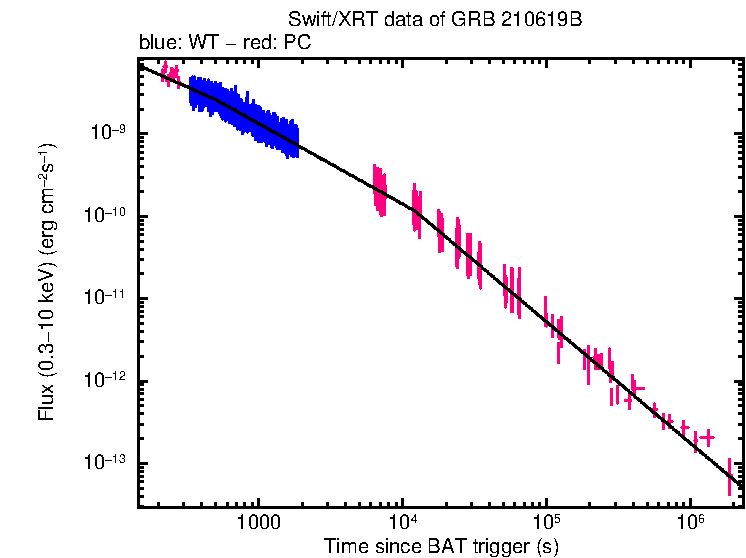
Figure 2. The XRT light curve.
Any data from a crosshatched region are not included in the fit.
| RA (J2000) | Dec (J2000) | Error | Note | Reference |
|---|---|---|---|---|
| 2 |
+33°51'01.6" | 0.42" | UVOT-refined | Kuin and D'Avanzo GCN Circ. 30278 |
| 2 |
+33°51'00.2" | 1.9" | XRT-final | UKSSDC |
| 2 |
+33°51'00.1" | 2.1" | XRT-enhanced | Beardmore et al. GCN Circ. 30267 |
| 2 |
+33°50'58.6" | 1.0' | BAT-refined | Lien et al. GCN Circ. 30282 |
| Band | Authors | GCN Circ. | Subject | Observatory | Notes |
|---|---|---|---|---|---|
| Optical | Jelinek et al. | 30263 | Ondrejov D50 detection | D50 | detection |
| Optical | Kong | 30265 | iTelescope T18 detection | iTelescope | detection |
| Optical | Pellegrin and Anandagoda | 30268 | SARA-KP 0.9m Optical Afterglow Detection | SARA | detection |
| Optical | Perley | 30271 | Liverpool telescope imaging of a red afterglow |
Liverpool Telescope | |
| Optical | de Ugarte Postigo et al. | 30272 | Redshift from OSIRIS/GTC | GTC | redshift |
| Optical | Zheng and Filippenko | 30273 | KAIT Optical Detection | KAIT | detection |
| Optical | Blazek et al. | 30274 | Liverpool Telescope r'-band observations | Liverpool Telescope | detection |
| Optical | Kann et al. | 30275 | CAHA 2.2m photometric monitoring | CAHA | detection |
| Optical | Xin et al. | 30277 | Xinglong TNT optical observations | TNT | |
| Optical | Shrestha et al. | 30280 | Liverpool Telescope First Hour Observations |
Liverpool Telescope | |
| Optical | Jelinek et al. | 30281 | steepening of the decay observed at the D50 |
D50 | |
| Optical | Kumar et al. | 30286 | GIT optical follow-up and confirmation of jet-break |
GROWTH-India Tel. | detection |
| Optical | D'Avanzo et al. | 30288 | REM optical/NIR afterglow detection | REM | detection |
| Optical | D'Avanzo et al. | 30289 | TNG NIR observations of the afterglow | TNG | |
| Optical | Cunningham et al. | 30290 | SEDM Optical Observations | Spectral Energy Distribution Machine at Palomar | |
| Optical | Moskvitin and Maslennikova | 30291 | SAO RAS optical observations | SAO RAS | detection |
| Optical | 30292 | iTelescope optical afterglow observation | iTelescope | ||
| Optical | Hu et al. | 30293 | 1.5m OSN optical observation | Obs.de Sierra Nevada | detection |
| Optical | Zhu et al. | 30294 | NOT optical observations | NOT | detection |
| Optical | Belkin et al. | 30299 | AbAO optical observations | Abastumani Astro. Obs. | detection |
| Optical | Moskvitin and Maslennikova | 30303 | Further SAO RAS optical observations | SAO RAS | detection |
| Optical | Romanov and Lane | 30305 | Abbey Ridge Observatory optical afterglow observation |
Abbey Ridge Obs. | |
| Optical | Karpov et al. | 30308 | Mini-MegaTORTORA early optical observations |
TORTORA | light curve |
| Optical | Moskvitin and Maslennikova | 30309 | Even further SAO RAS optical observations |
SAO RAS | detection |
| Optical | Vinko et al. | 30320 | optical afterglow detection from Konkoly Observatory |
Konkoly | detection |
| Optical | Kann et al. | 30338 | Deep CAHA 2.2m detection and late-time light curve behavior |
CAHA | light curve |
| Optical | Zaznobin et al. | 30343 | Sayan observatory 1.6-m telescope observations |
Sayan Obs. | detection |
| Optical | Belkin et al. | 30791 | Maidanak and Assy optical observations, broken power law parametrization |
Assy-Turgen Obs. | detection |
| Radio | Smith et al. | 30361 | JCMT SCUBA-2 sub-mm observations | SCUBA | |
| Radio | Laskar et al. | 30386 | ALMA detection | ALMA | detection |
| Gamma-ray | Zhao et al. | 30264 | GECAM detection | GECAM | |
| Gamma-ray | Axelsson et al. | 30270 | Fermi-LAT detection | Fermi LAT | |
| Gamma-ray | Svinkin et al. | 30276 | Konus-Wind detection | Konus-Wind | Fluence=4.60(-0.13,+0.13)x1 |
| Gamma-ray | Poolakkil and Meegan | 30279 | Fermi GBM detection | Fermi GBM | Fluence=307.93±0.9830x1 (brighter than 99.9% of long GRBs) |
| Gamma-ray | Levin et al. | 30283 | SRG/ART-XC detection | SRG/ART | |
| Gamma-ray | Kawakubo et al. | 30284 | CALET Gamma-Ray Burst Monitor detection | CALET | |
| Gamma-ray | Minaev et al. | 30304 | SPI-ACS/INTEGRAL observations | INTEGRAL | |
| Gamma-ray | Marisaldi et al. | 30315 | ASIM observation | Atmosphere-Space International Monitor | |
| Other | 30301 | possibility of lensed visible afterglow? |
| Filter | Exp(s) | Mag | ||
|---|---|---|---|---|
| white | 136 | 285 | 147 | 14.67 ± 0.02 |
| white | 794 | 814 | 19 | 16.66 ± 0.06 |
| v | 679 | 699 | 19 | 15.59 ± 0.10 |
| b | 604 | 624 | 20 | 16.39 ± 0.08 |
| u | 348 | 598 | 246 | 15.60 ± 0.03 |
| w1 | 729 | 1107 | 39 | 17.22 ± 0.19 |
| m2 | 704 | 1776 | 117 | >19.3 |
| w2 | 655 | 1726 | 136 | 19.20 ± 0.31 |
Table 3. UVOT observations reported by Kuin and D'Avanzo (GCN Circ. 30278). The start and stop times of the exposures are given in seconds since the BAT trigger. The preliminary detections and 3-σ upper limits are given. No correction has been made for extinction in the Milky Way.
September 10, 2021