
V. D'Elia (ASDC), Z. Liu (NAOC / U. Leicester) and M.H. Siegel (PSU) for the Swift team
At 06:44:06 UT, the Swift Burst Alert Telescope (BAT) triggered and located GRB 180418A (trigger=826428) (D'Elia et al. GCN Circ. 22646). Swift could not immediately slew to the burst due to an observing constraint. At the time of the trigger, the initial BAT position was 130° from the Sun (9.6 hours East) and 105° from the 6%-illuminated Moon. Table 1 contains the best reported positions from Swift, and the latest XRT position can be viewed at http://www.swift.ac.uk/xrt_positions.
Zheng and Filippenko (GCN Circ. 22647) reported the position from KAIT for the optical afterglow of this GRB. Siegel and D'Elia (GCN Circ. 22665) reported the detection with UVOT of an optical afterglow. Fong et al. (GCN Circ. 22659) determined a redshift of 0.5 from Gemini. Table 2 is a summary of GCN Circulars about this GRB from observatories other than Swift.
Standard analysis products for this burst are available at https://gcn.gsfc.nasa.gov/swift_gnd_ana.html.
As reported by Palmer et al. (GCN Circ. 22658),
the BAT ground-calculated position is RA, Dec = 170.132, 24.925 deg which is RA(J2000) = 1
The mask-weighted light curve (Figure 1) shows a single FRED-like pulse that starts at ~
The time-averaged spectrum from T+0.10 to T+3.50 s is best fit by a simple power-law model.
The power law index of the time-averaged spectrum is 1.44 ± 0.12.
The fluence in the 15-150 keV band is 3.2 ± 0.2 x 1
Using a 16-ms binned light curve (Figure 1) , the lag analysis finds a lag of 0.1000 ± 0.026 s for the 100-350 keV to 25-50 keV band, and 0.088 ± 0.026 s for the 50-100 keV to 15-25 keV band. These values are also intermediate between canonical short and long GRBs.
The results of the batgrbproduct analysis are available at https://gcn.gsfc.nasa.gov/notices_s/826428/BA/.
Analysis of the initial XRT data was reported by Liu et al. (GCN Circ. 22655). We have analysed 41 ks of XRT data for GRB 180418A, from 3.1 ks to 1852.2 ks after the BAT trigger. The data are entirely in Photon Counting (PC) mode. The enhanced XRT position for this burst was given by Goad et al. (GCN Circ. 22650).
The light curve (Figure 2) can be modelled with a power-law decay with a decay index of α=0.88 (+0.08, -0.07).
A spectrum formed from the PC mode data can be fitted with an absorbed power-law with a photon spectral index of 2.02 (+0.28, -0.26). The best-fitting absorption column is 8.0 (+7.1, -5.8) x 1
A summary of the PC-mode spectrum is thus:
Total column: 8.0 (+7.1, -5.8) x 1
Galactic foreground: 1.1 x 1
Excess significance: 2.0 σ
Photon index: 2.02 (+0.28, -0.26)
The results of the XRT team automatic analysis are available at http://www.swift.ac.uk/xrt_products/00826428.
The Swift/UVOT began settled observations of the field of GRB 180418A 3086 s after the BAT trigger
(Siegel and D'Elia GCN Circ. 22665).
A fading source consistent with the XRT position (Goad et al. GCN Circ. 22650) is detected in the initial UVOT exposures, confirming the previously reported optical afterglows (Zheng & Filippenko, GCN Circ. 22647; Guidorzi et al., GCN Circ. 22648; Troja et al., GCN Circ. 22652; Fong et al., GCN Circ. 22659; Malesani et al., GCN Circ. 22660; Schady et al., GCN Circ. 22662; Misra et al., GCN Circ. 22663).
Table 3 gives preliminary
magnitudes using the UVOT photometric system
(Breeveld et al. 2011, AIP Conf. Proc., 1358, 373).
No correction has been made for the expected extinction in the Milky Way
corresponding to a reddening of
Figure 1. The BAT
mask-weighted light curve in the four individual and total
energy bands. The units are counts
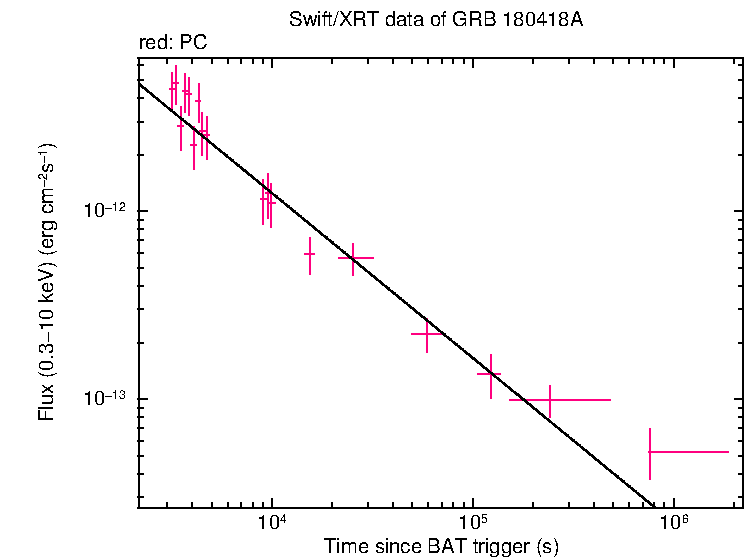
Figure 2. The XRT light curve.
Any data from a crosshatched region are not included in the fit.
| RA (J2000) | Dec (J2000) | Error | Note | Reference |
|---|---|---|---|---|
| 1 |
+24°55'59.2" | 0.49" | UVOT-refined | Siegel and D'Elia GCN Circ. 22665 |
| 1 |
+24°55'59.1" | 1.6" | XRT-final | UKSSDC |
| 1 |
+24°55'59.1" | 1.8" | XRT-enhanced | Goad et al. GCN Circ. 22650 |
| 1 |
+24°55'28.9" | 1.2' | BAT-refined | Palmer et al. GCN Circ. 22658 |
| Band | Authors | GCN Circ. | Subject | Observatory | Notes |
|---|---|---|---|---|---|
| Optical | Zheng and Filippenko | 22647 | KAIT Optical Afterglow Candidate | KAIT | detection |
| Optical | Guidorzi et al. | 22648 | LCO FTN afterglow confirmation | FTN | detection |
| Optical | Troja et al. | 22652 | RATIR Optical Observations | RATIR | |
| Optical | Sota et al. | 22657 | 1.5m OSN optical observations | Obs.de Sierra Nevada | |
| Optical | Fong et al. | 22659 | Gemini-North imaging and spectroscopy | Gemini | spectroscopy |
| Optical | Malesani et al. | 22660 | NOT optical observations | NOT | |
| Optical | Xin et al. | 22661 | Xinglong TNT optical upper limit | TNT | upper limits |
| Optical | 22662 | GROND observations | GROND | detection | |
| Optical | Misra et al. | 22663 | Imaging of the optical afterglow with the 1.3 m DFOT and 3.6 m DOT in ARIES, India |
Devasthal Opt.Tel. | detection |
| Optical | Troja et al. | 22664 | Continued RATIR Optical Observations | RATIR | detection |
| Optical | Schady and Chen | 22666 | Further GROND observations | GROND | detection |
| Optical | Choi et al. | 22668 | SQUEAN observations | SQUEAN | |
| Optical | Horiuchi et al. | 22670 | MITSuME Ishigakijima Optical Observation | MITSuME Ishigakijima | detection |
| Optical | Klotz et al. | 22671 | TAROT La Silla observatory early optical observations |
TAROT | |
| Radio | Bright et al. | 22697 | 15 GHz upper limits from AMI | AMI | upper limits |
| Gamma-ray | Bissaldi and Veres | 22656 | Fermi GBM observation | Fermi GBM | Fluence=7.6±0.4x1 ( |
| Filter | Exp(s) | Mag | ||
|---|---|---|---|---|
| white (fc) | 3087 | 3236 | 147 | 19.19± 0.11 |
| white | 3087 | 4470 | 344 | 19.45± 0.09 |
| white | 49806 | 72093 | 4850 | >22.62 |
| v | 3243 | 4835 | 347 | >19.53 |
| b | 4064 | 4264 | 196 | >20.19 |
| b | 15510 | 16114 | 590 | >20.82 |
| u (fc) | 3859 | 4059 | 196 | 19.35± 0.24 |
| u | 14598 | 31858 | 894 | >20.73 |
| uvw1 | 3655 | 3855 | 196 | 19.19± 0.28 |
| uvw1 | 9720 | 27635 | 1206 | 20.02± 0.21 |
| uvm2 | 3450 | 3649 | 196 | 18.93± 0.27 |
| uvm2 | 8814 | 26975 | 2165 | 20.65± 0.26 |
| uvw2 | 4476 | 4676 | 196 | >19.69 |
Table 3. UVOT observations reported by Siegel and D'Elia (GCN Circ. 22665). The start and stop times of the exposures are given in seconds since the BAT trigger. The preliminary detections and 3-σ upper limits are given. No correction has been made for extinction in the Milky Way.
May 11, 2018