
K.L. Page (U. Leicester) and V. D'Elia (ASDC) for the Swift team
At 02:59:34 UT, the Swift Burst Alert Telescope (BAT) triggered and located GRB 190220A (trigger=889785) (Page et al. GCN Circ. 23908). Swift slewed immediately to the burst. At the time of the trigger, the initial BAT position was 66° from the Sun (0.2 hours West) and 115° from the 100%-illuminated Moon. Table 1 contains the best reported positions from Swift, and the latest XRT position can be viewed at http://www.swift.ac.uk/xrt_positions.
Page et al. (GCN Circ. 23908) reported the discovery with UVOT of an optical afterglow. Table 2 is a summary of GCN Circulars about this GRB from observatories other than Swift.
Standard analysis products for this burst are available at https://gcn.gsfc.nasa.gov/swift_gnd_ana.html.
As reported by Barthelmy et al. (GCN Circ. 23914),
the BAT ground-calculated position is RA, Dec = 330.128, -76.669 deg which is RA(J2000) = 2
The mask-weighted light curve (Figure 1) shows a single-pulse structure that starts at ~
The time-averaged spectrum from T-0.12 to T+11.88 s is best fit by a power law with an exponential cutoff.
This fit gives a photon index 0.79 ± 0.77, and
The results of the batgrbproduct analysis are available at https://gcn.gsfc.nasa.gov/notices_s/889785/BA/.
Analysis of the initial XRT data was reported by D'Elia et al. (GCN Circ. 23917). We have analysed 10 ks of XRT data for GRB 190220A, from 68 s to 120.7 ks after the BAT trigger. The data comprise 67 s in Windowed Timing (WT) mode (the first 8 s were taken while Swift was slewing) with the remainder in Photon Counting (PC) mode.
The light curve (Figure 2) can be modelled with an initial power-law decay with an index of α=2.4 (+0.3, -0.4), followed by a break at T+177 s to an α of 1.08 ± 0.08.
A spectrum formed from the PC mode data can be fitted with an absorbed power-law with a photon spectral index of 1.69 (+0.25, -0.23). The best-fitting absorption column is 3.9 (+1.5, -1.2) x 1
A summary of the PC-mode spectrum is thus:
Total column: 3.9 (+1.5, -1.2) x 1
Galactic foreground: 1.1 x 1
Excess significance: 3.7 σ
Photon index: 1.69 (+0.25, -0.23)
The results of the XRT team automatic analysis are available at http://www.swift.ac.uk/xrt_products/00889785.
UVOT results are not available.
Figure 1. The BAT
mask-weighted light curve in the four individual and total
energy bands. The units are counts
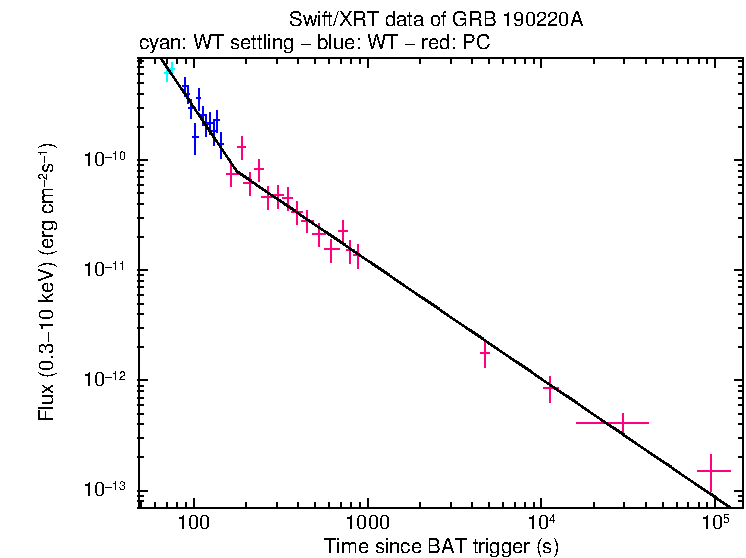
Figure 2. The XRT light curve.
Any data from a crosshatched region are not included in the fit.
| RA (J2000) | Dec (J2000) | Error | Note | Reference |
|---|---|---|---|---|
| 2 |
-76°40'50.4" | 0.66" | UVOT-initial | Page et al. GCN Circ. 23908 |
| 2 |
-76°40'52.5" | 1.5" | XRT-final | UKSSDC |
| 2 |
-76°40'52.5" | 1.5" | XRT-enhanced | Evans et al. GCN Circ. 23912 |
| 2 |
-76°40'10.1" | 1.3' | BAT-refined | Barthelmy et al. GCN Circ. 23914 |
| Band | Authors | GCN Circ. | Subject | Observatory | Notes |
|---|
February 22, 2019