
The Neil Gehrels Swift Observatory
 Gamma-ray bursts (GRBs) are the most powerful explosions the Universe has seen since the Big Bang. They occur approximately once per day and are brief, but intense, flashes of gamma radiation. They come from all different directions of the sky and last from a few milliseconds to a few hundred seconds. So far scientists do not know what causes them. Do they signal the birth of a black hole in a massive stellar explosion? Are they the product of the collision of two neutron stars? Or is it some other exotic phenomenon that causes these bursts?
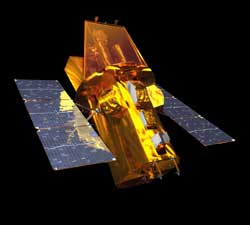
With Swift, a NASA mission with international participation, scientists have a tool dedicated to answering these questions and solving the gamma-ray burst mystery. Its three instruments give scientists the ability to scrutinize gamma-ray bursts like never before. Within seconds of detecting a burst, Swift relays its location to ground stations, allowing both ground-based and space-based telescopes around the world the opportunity to observe the burst's afterglow. Swift is part of NASA's medium explorer (MIDEX) program and was launched into a low-Earth orbit on a Delta 7320 rocket on November 20, 2004. The Principal Investigator is Dr. Brad Cenko (NASA-GSFC).

» NASA Release

Swift Operations Status
Operations are nominal.
Swift Resources
» GRB, BA, & TOO Contact Information» BAT Transient Lightcurves
» Swift Supernovae
» Observing Schedule
» Journal Papers Related to Swift
» Swift Press Release Image Archive
» Swift Mission Participants
Latest Swift GRBs
Latest Swift News
Aug 28, 2026
NASA's Swift Restarts Science Observations
NASA's Neil Gehrels Swift Observatory has resumed operating two of its three science instruments, following the scaling back of a commercial mission that would have boosted Swift to a higher orbital altitude. That mission is now focused on demonstrating rendezvous technologies for in-space servicing.
+ Read More
Aug 19, 2026
NASA Updates Next Steps for Commercial Swift Boost Mission
Due to an ongoing commercial spacecraft attitude control issue, NASA and Katalyst Space announced Wednesday the LINK spacecraft will not capture or boost an agency satellite to a higher altitude to extend its science mission as planned.
+ Read More
Aug 11, 2026
NASA Swift Boost Spacecraft Prepares to Continue Mission
Katalyst Space successfully uploaded a flight software update for its LINK spacecraft, which is set to boost NASA's Neil Gehrels Swift Observatory to a higher orbit. The software update's new attitude control algorithms are designed to maintain LINK's stability using the spacecraft's remaining actuators.
+ Read More

- Curator: J.D. Myers
- NASA Official & Swift PI: Brad Cenko
- PAO Contact: Francis Reddy
- Questions/Comments/Feedback
- › Privacy Policy and Important Notices
- › Accessibility
- › Contact NASA
- › Page Last Updated: Wed, Sep 23, 2026